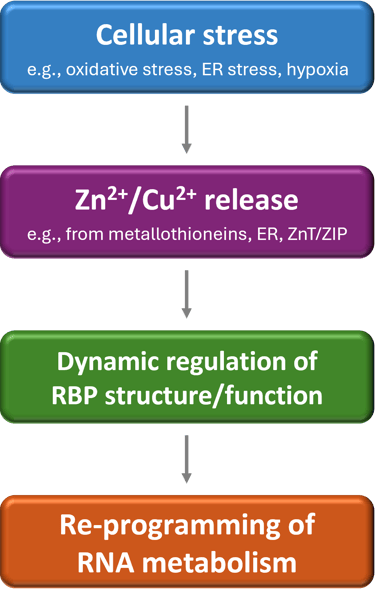
Divalent cations such as Zn2+ and Cu2+ regulate the activity of RNA-binding proteins in the capacity of second messengers during physiological signaling (e.g., during cellular stress). Notably, such mechanisms are not as well understood as for the role of these metals as structural cofactors. In the context of disease, particularly with regard to neurodegenerative disorders, metal ion dyshomeostasis can exert pathological effects on protein structure and function. In other words, metal-dependent signaling can trigger both adaptive and maladaptive reprogramming of RNA metabolism during intracellular signaling.
I. Dynamic regulation of RNA-binding proteins by divalent metal cations - biophysical studies
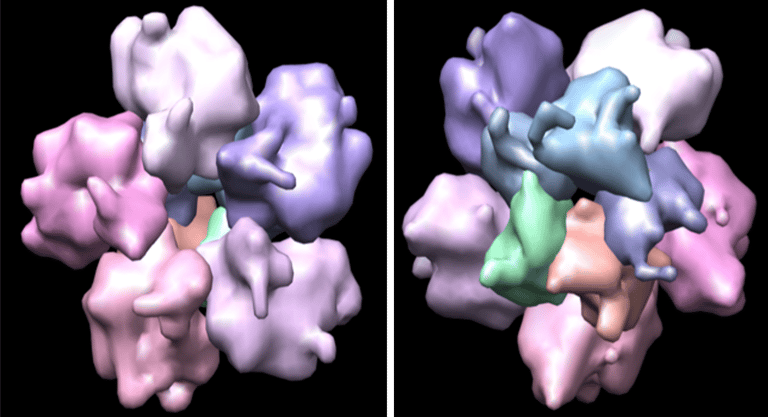
In parallel with in vitro biophysical and biochemical studies, we are generating high-resolution structures of RNA-binding proteins in complex with metal ligands using cryo-EM and other advanced methodologies. Combining structural and functional data will generate new insight into how RNA-binding proteins may be tuned by metal cations to elicit dynamic and adaptive (or maladaptive) changes in RNA metabolism. Tentative cryo-EM structures of one of several RNA-binding proteins dynamically regulated by metal ligands is shown below (X. Li, Rayman Lab, unpublished data/protein undisclosed).
II. Dynamic regulation of RNA-binding proteins by divalent metal cations - structural studies
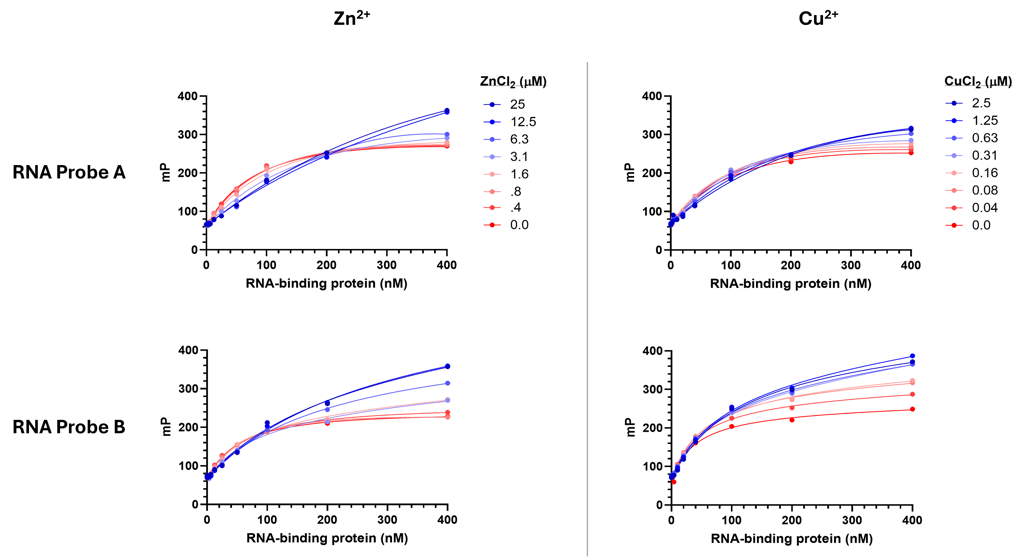
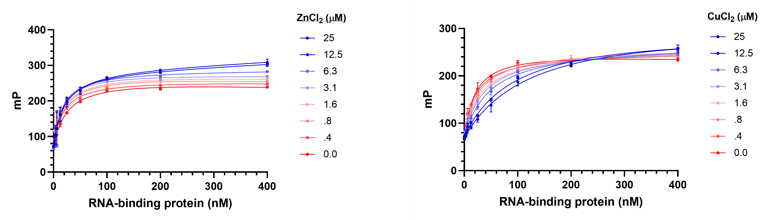
The graphs below are from an in vitro fluorescence polarization (FP) assay that measures the impact of metal cations on the ability of an exemplary RNA-binding protein (unpublished data/undisclosed) to interact with labeled RNA probes. The data show that FP is differentially sensitive to cation type, concentration range, RNA sequence, and protein:RNA ratio. Apparent Kds and Bmax values from these graphs, together with other biophysical data, provide novel insight into structure and function of RNA-binding proteins dynamically regulated by metal cations.
Notably, different proteins exhibit distinct metal response profiles. Below are FP data from a second RNA-binding protein with RNA binding profiles and metal responsiveness that are dissimilar from the previous data. Again, metal ions may differentially impact both protein:RNA affinity as well as conformational state, as determined by FP and other biophysical evidence.
Taken together, these observations suggest that proteins and their functional networks may undergo metal ligand-dependent tuning of protein synthesis and other aspects of RNA metabolism. These results have significant implications for both physiological and maladaptive or pathophysiological metal-dependent signaling.